Create a sales-enhancing environment in your store
In this article, you will learn how the in-store environment and product placement affect sales.
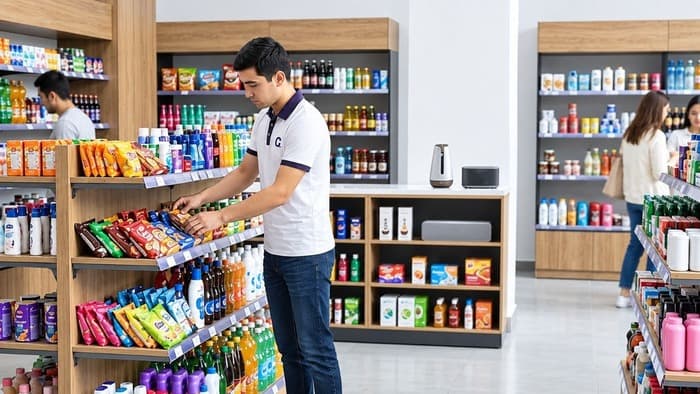
We often hear people say, "I went to the store for one thing and took out ten things."
Indeed, many people make unplanned purchases when they enter a store and have extra money with them. This is called an impulsive purchase.
An impulsive purchase is a purchase decision that was not planned in advance, but was made suddenly at the time of purchase due to momentary emotions, strong desire, or the influence of external factors.
During an impulsive purchase, the buyer often does not think about whether they need the product or not, or about the financial consequences of this purchase.
There are several external factors that can lead to such a purchase. Among them, the environment in the store and the location of the products are among the most important reasons.
Creating a comfortable and pleasant environment for customers in the store and placing products based on their psychology has a positive impact on sales.
Large supermarkets and shopping centers around the world pay great attention to this issue and increase sales.
So how do they do it? Let's take a closer look at this below:
1. Try to create a positive impression during the introduction.
The first steps to the store determine the outcome of the entire purchase. At the entrance, the buyer adapts to the atmosphere of the store.
If the store entrance is cluttered and filled with advertisements, it makes it difficult for the customer to adapt.
It is recommended to have lighting at the entrance that is not too bright, soft enough to avoid eye strain, and with fewer advertisements.
2. Guide the customer with a custom location
In large supermarkets, department stores, and clothing stores, the "race track" tactic is used to ensure that customers pass through all departments.
This method is used to ensure that customers pass through all departments. Because a customer passing through all departments increases their likelihood of purchasing more products.
In this case, the main track is constructed along the perimeter of the store or in the form of a clear ring, resembling a running track.
As a result, the buyer has the opportunity to view all departments in the store without getting lost.
In racing track tactics, the tracks must be sufficiently wide. Otherwise, traffic jams may arise, causing inconvenience to customers.
It is necessary to place the most attractive, fresh or discounted products at the turning points and central parts of the ring road.
The customer must be able to see other parts of the store from the corridor. This encourages him to move on to the next sections.
Placing special directional signs around the store helps the customer quickly find out where and what is being sold.
However, such signs should not cause inconvenience to the client or make walking difficult. Therefore, it is important to pay attention to comfort.
3. Create a calm and pleasant atmosphere.
Most customers may not like the fact that noisy music is playing in the store. Because most customers want to walk around the store and shop in peace.
Calm, inspiring music helps the client relax. This can cause him to visit the store more often and make more purchases.
But that doesn't mean you have to play sad, long-winded music. Pay attention to moderation in everything.
It is also necessary to have a pleasant smell coming from the store. It is advisable to monitor the section of products that can spoil and smell.
A pleasant fragrance helps form emotional connections, encourages staying longer, and sometimes increases sales.
In addition, one of the important issues is how to light up the store. Because it shapes the mood of the customers.
According to world experience, in the sale of fast-moving goods, it is necessary to light up the store brightly and evenly.
Relatively dim lighting gives a luxurious, luxury store an exclusive vibe.
4. Focus on customer psychology and needs in product placement.
According to global experience, most buyers prefer products that are in their natural line of sight.
That is, they pay more attention to products that are right in front of them and look for what they need there.
Therefore, it is advisable to place high-demand and premium products on the top shelves of the counter.
Also, placing products that are used together closer to each other or next to each other can have a positive impact on sales.
Because a person who buys a product naturally needs something else that is used along with it.
If you put the two products side by side, the customer will be more likely to put the second one in the cart without thinking.
For example, you can arrange food products such as coffee, sugar and milk in this way.
5. Monitor the sales process and plan the departments correctly.
In special POS systems, it is possible to obtain reports on which products are being sold and at what speed.
And from the cameras, you can see which parts of the store customers are avoiding the most during the purchase process.
Based on your tracking results, you can make changes to the placement of products that are selling slowly or not at all.
These recommendations are based on international experience. We hope it will be useful for you as well.