What is a business model? Types of business models
What is a business model and what types of business models are there? This article provides detailed information about B2B, B2C, B2G, D2C, C2C, franchising, subscription, freemium, and other business models.
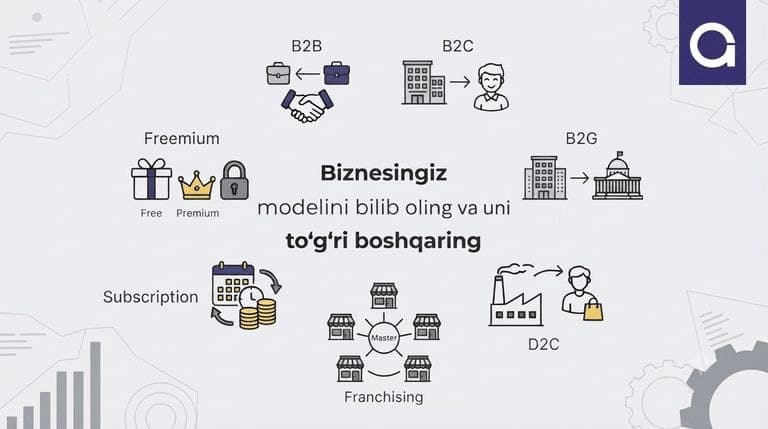
The success of any business does not depend solely on a good product or service. Whom the company sells to, what value it creates, how it finds the customer, how it delivers the product or service, and how it generates revenue from this — all of these are important parts of a business model.
A business model is a system that represents how a company offers value to customers, how it delivers this value, and how it generates revenue in return.
Why is it important to know the business model? A company without a clear business model often makes random decisions in advertising, sales, and customer relations.
For example, if an enterprise provides services to other companies, its method of attracting customers differs significantly from a business that sells products to regular consumers.
In a B2B company, the sales process may be longer, multiple individuals may be involved in decision-making, and commercial proposals, meetings, and negotiations can play an important role.
In B2C business, however, advertising, brand, price, promotions, a convenient purchasing process, and the customer's emotional decision are of great importance.
Therefore, understanding the business model allows an entrepreneur to: — identify the right target audience; — choose appropriate advertising channels; — shape the sales process; — determine the pricing policy; — improve customer relationships; — increase revenue streams; — expand the business.
What types are business models divided into? It is not correct to classify business models based on a single criterion.
Because one type of business model shows who the customer is, another shows how revenue is generated, and yet another shows how the product is delivered to the customer.
Below are the most common business models among entrepreneurs.
1. B2B (Business to Business) — is a model of one business selling a product or service to another business. In this, the final buyer is not a regular consumer, but another company or organization.
Examples of B2B business: a marketing agency providing SMM services to companies, an IT company selling software to an enterprise, and the like.
2. B2C (Business to Consumer) — is a model of a business selling a product or service directly to the final consumer.
This is one of the most common business models in daily life: shops selling various products, restaurants and cafes, beauty salons, supermarkets.
3. B2G (Business to Government) — is a model of commercial relations between private business and government organizations. In this, the company can deliver products or provide services to government organizations.
For example: delivering equipment for government organizations, manufacturing furniture, creating IT systems, and the like.
4. D2C (Direct to Consumer) — is a model of a manufacturer selling products directly to the final consumer without intermediaries.
In this model, the manufacturer offers the product to the customer through its online store, mobile application, social media page, and other direct sales channels.
5. C2C (Consumer to Consumer) — is a model of one consumer selling a product or service to another consumer.
For example, a person selling their used phone, furniture, clothing, or car to another individual. Such a model is often carried out through classified ad platforms and marketplaces.
6. C2B (Consumer to Business) — is an individual or independent specialist offering a product or service to a business.
For example: a freelancer providing design services to a company, a blogger advertising a company's product, or a copywriter writing text for a business.
7. B2B2C (Business to Business to Consumer) — is a model of a business reaching the final consumer through another business.
In this model, one company cooperates with a second company, and through this cooperation, the product or service reaches the final customer.
For example, a manufacturing company cooperates with a marketplace. The marketplace then offers the product to the final consumer.
In our next article, we will also provide information on business models regarding how a business generates revenue.