Business models by revenue generation method
In this article, the types of businesses based on their revenue generation method are detailed with examples.
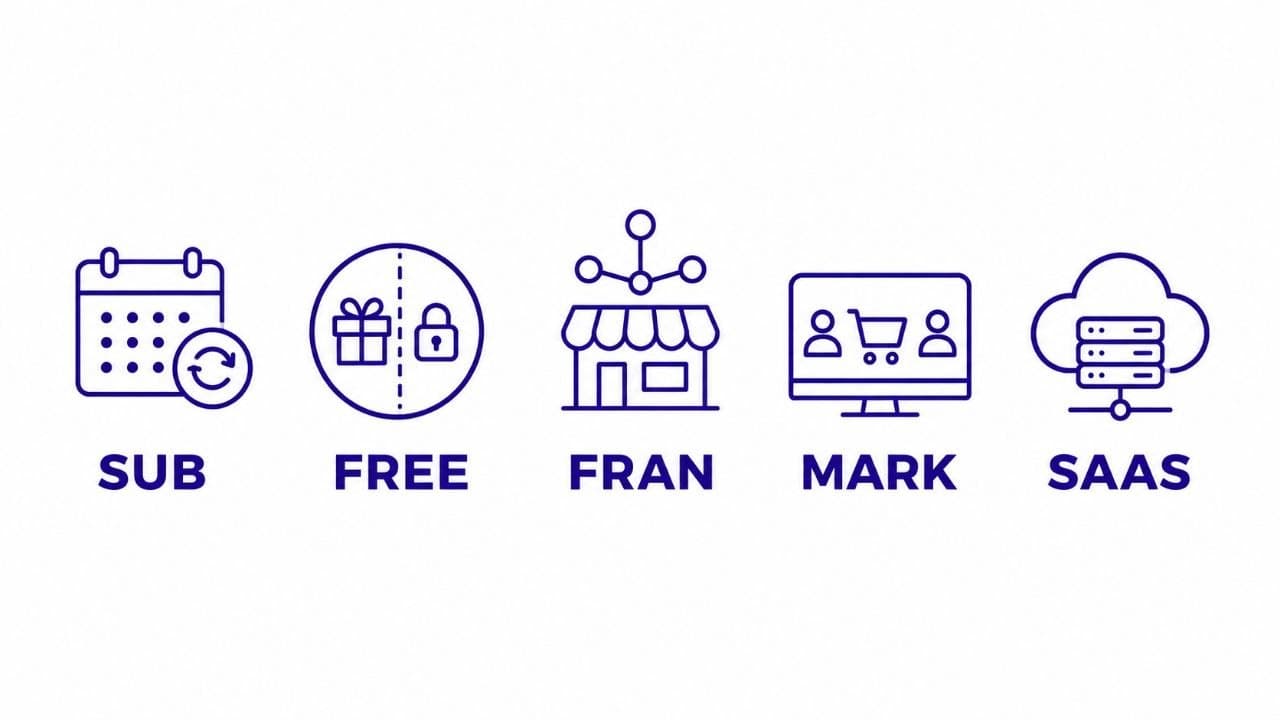
To understand a business model, it is also necessary to know how revenue is generated.
Depending on the method of generating revenue, the following business models are widely used:
Subscription — subscription model
This is a model where a customer makes regular payments, for example, monthly or annually, to use a product or service.
Examples include: online education platforms, software services, streaming platforms, gyms, paid media, and content services.
The main advantage of the subscription model is that it allows a business to generate a recurring revenue stream.
In this case, along with finding a new customer, retaining the existing customer for a longer period becomes crucial for the company.
Freemium model — a model where the basic version of a product or service is provided for free, and a fee is charged for additional features.
For example, a user can utilize the free functions of the service, but upgrades to a premium plan for expanded capabilities, ad-free usage, or extra features.
This model is particularly widely used in digital products and mobile applications.
The purpose of the freemium model is to allow the user to try the product first and later convert a portion of them into paying customers.
Franchising model — granting the right to use an existing brand, business concept, standards, and operational system to another entrepreneur.
The franchisor is the owner of the brand and business system. The franchisee uses this system based on specified conditions.
For example, a famous restaurant or service brand can grant the right to use its name and business system to another entrepreneur.
The advantage of franchising is that instead of creating a business entirely from scratch, the entrepreneur utilizes an already established brand and business system.
Marketplace model — a business model that connects various sellers and buyers on a single platform.
The marketplace may not produce the products itself. Its main task is to organize the trade between the seller and the buyer.
Revenue can be generated through:
sales commission;
listing fees;
advertising;
premium services;
logistics or additional services.
In the marketplace model, the growth in the number of sellers and buyers on the platform is a key factor for the business.
SaaS (Software as a Service) — a model of providing software as a service over the internet, rather than selling it once as a product.
The customer can make monthly or annual payments to use the software. Examples of the SaaS model include:
CRM systems;
project management platforms;
accounting software;
marketing tools;
online collaboration services.